How pistachios are harvested and sun-dried
Every Lian pistachio starts on a tree in our family orchard in Iran. Between the spring blossom and the pack on your table there are a few short weeks of harvest work, and in those weeks timing decides almost everything. Here is how it is done, step by step, the way our family has done it for half a century.
A year on the pistachio tree
Pistachio trees blossom in spring, and the nuts grow through the long, hot summer. The shell forms first and hardens; then, in the second half of summer, the kernel fills it out. When the kernel is fully grown, it gently pushes the shell apart along its seam. This is the natural split that makes a good pistachio so easy to open. Pistachio trees also tend to alternate, with a heavier crop one year and a lighter one the next, which is one reason harvests and prices change from season to season.
Knowing when to pick
Harvest usually runs from early September to early October. The signs are clear to an experienced eye: the soft outer hull turns from green to a rosy, pinkish yellow, it starts to loosen from the shell, and most of the shells inside have split. Picked too early, the kernels are small and many shells stay closed. Picked too late, the hulls can stain the shells. Because nuts on the same tree do not ripen at exactly the same moment, the timing is a judgement made tree by tree.
Picked by hand
We pick our pistachios by hand. Clusters are gathered from the branches onto clean sheets or into baskets, so the nuts never lie on bare soil. Hand-picking is slower than mechanical shaking, but it is gentler on the trees and the nuts, and it lets the pickers leave clusters that are not yet ripe for a later pass. It is the traditional way, and it is still the way we harvest.
Hulling within 24 hours
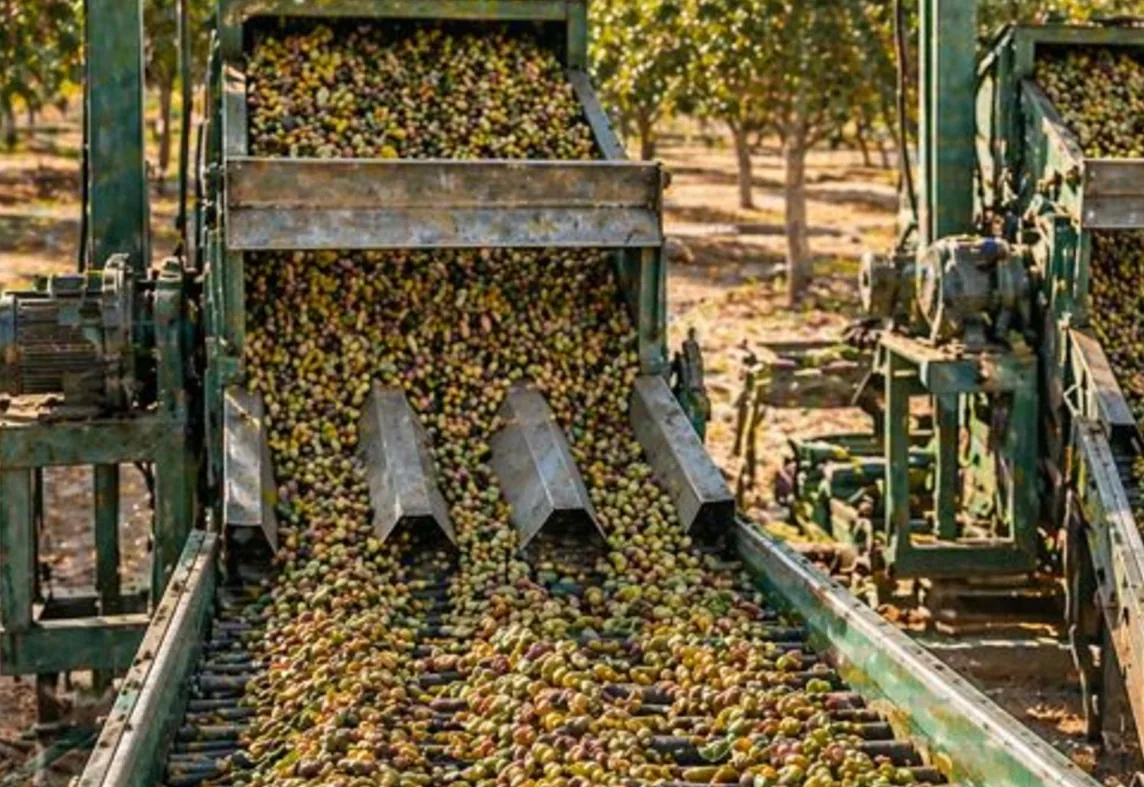
Freshly picked pistachios are still wrapped in their soft hull, and it has to come off quickly, ideally within 24 hours of picking. If it stays on, it stains the shell dark, and warm, damp hulls are exactly what good food-safety practice avoids. After hulling, the nuts are washed and passed through water: well-filled nuts sink, while empty and underdeveloped ones float and are removed. Quick hulling is why our shells stay light, clean and bright.
Drying under the sun
A fresh pistachio holds far too much moisture to keep. Drying brings it down to around 5–7% or lower, the level at which pistachios stay crisp and store well. We dry ours only under the natural sun, spread in thin layers on clean surfaces and turned regularly so that every nut dries evenly. In the dry, sunny weather of harvest time this takes a few days. Many large producers dry with hot air instead; sun-drying is the traditional method our family has always used, and it lets the kernel firm up slowly and keep its full, sweet flavour.
Sorting and grading
Once dry, the harvest is sorted with care before anything leaves the orchard:
- Size: nuts are graded by how many fit in one ounce, from 20–22 (the largest) to 30–32.
- Open shells: closed nuts are separated out; a premium lot reaches 90–95% open shell.
- Appearance: stained, damaged or empty shells are removed.
- Safety: lots are checked for moisture and for aflatoxin, in line with EU limits.
From harvest to your pack
Only then is a lot ready for its final form: kept raw, roasted and salted, or roasted with saffron, our signature product. Our retail packs are led by Kalleh Ghoochi, large, open and rich in flavour, while shops, cafés and importers buy in bulk, in shell or as kernels. To know what to look for when pistachios arrive, read our guide to judging pistachio quality.